I sat across from my friend, at the pub by the fountain. Her notebook was open, pen in mid-air, waiting for my input on the ideas we’d just discussed. My own notebook still closed. I stirred what was left of the breakfast tea, watching the stains on the teapot and wondering how many people had drunk from it before. She was talking about launching a newsletter for the community project we’d been running for the last ten or so months. When I glanced up, she had stopped writing. I think she could tell something had shifted.
“But, like” she said, her voice trembling and betraying her initial excitement, “do you still want to be in?”
I felt the air getting colder. My mouth opened, then closed again.
The question followed me home and hovered over my dinner. It took me seven days of pacing around my flat, one abandoned email draft, and two long walks on the cliff to formulate an answer.
There’s no shortage of advice on how to say no. I checked online before writing this and I’m seeing hundreds of frameworks and fill-in-the-blank email templates. There seems to be something for every occasion. Entire books on the art of declining “gracefully”, whatever that means. Use the shit sandwich. The “positive No”. And other suchlike bullshit. If you dig deep, I’m sure some of it is genuinely helpful—but only IF you’ve already decided.
How do you decide though? How do you weigh your Nos against your Yesses?
This is the story of how I did it.
But first, let me rewind to a couple million years ago and summon my inner David Attenborough.
During Pleistocene times, early humans lived in tribes. If you stayed loyal to the tribe you’d have higher odds of surviving. Whereas if you started asserting your boundaries, you’d risk being rejected by your tribe. This could mean you’d end up alone, without a “soulmate” (as far as romance went back then), and would soon be dead—almost certainly.
This predicament put a lot of pressure on the still-developing nervous system of our ancestors. Which is partly why my brain, and your brain, have learned to say Yes, keep people happy, and keep us allegiant to the tribe. To put it into perspective, your body spent something like 99.5% of its history in a world where “staying in the group’s good graces” was the only way to stay alive. It has only had about 0.5% of its evolutionary history to adjust to a world where you can survive perfectly fine even if your neighbour or colleague are unhappy with you.
As you can imagine, in today’s context, this tendency to agree is often counterproductive (unless you’re a contestant on The Traitors). We are hardwired to react to negotiations and stressful situations by being cooperative, even when it goes against our values and when saying “No” is the right thing to do.
As someone who never seems to be able to make a firm decision, I want to believe this is exactly the reason why.
I’m hardwired this way, baby! shakes his head I can’t help it!!!
I love resorting to anthropology to prove a point.
Back to the story.
When my friend and co-chair asked me if I was still in, I did everything that popular advice on “how to decline” tells you not to do. I waited, stalled, sat with the decision for days. I asked people around me what they thought, got pulled in so many directions, and all of it confused me even more. I played all the potential outcomes in my head until I felt this intense feeling of guilt running through me.
By the time this dilemma surfaced, I’d just spent a year sending out hundreds of applications and freelance pitches. I needed paid work, a stronger portfolio, and the energy to keep volunteering for the people I care about. And this project sat right in the middle—sometimes incredibly fulfilling, but often pulling me away from higher priorities. Even with my friend’s help, it rested predominantly on my shoulders and because of its many creative components, it had quietly become an outlet I reached for to avoid the “harder work” of marketing myself. Admitting this part, especially, wasn’t easy.
Saying “No, I want out” to my co-chair would mean giving up—or so I thought. And if I gave up, I would be judged. I didn’t want to be judged. I didn’t want to let a friend down. Nor did I want to see this project die.
Somewhere in the chaos of all that thinking, something landed: if I’m agonising about this decision this much, this isn’t a yes. When something is a yes, do you need a week to express it? Do you need to poll your friends? Do you need to lose sleep over it?
The signals were there, pointing roughly in one direction. In fact, about a week later, I went back to my friend and told her no. I said part of it in person and expanded on the rest later on in a message, leaving the door open to help from the sidelines. I didn’t follow any template or advice. But she was amazing and understood immediately. It was a very humbling moment actually, and I felt tense all the way through it—with relief coming back to comfort me only a couple of weeks later.
Most of the advice out there on “how to say No” hands you a script and tells you to be confident. But being confident about a decision like this doesn’t come from copy-pasting a template; rather, it comes from having sat in the discomfort long enough, until your body knows what’s right.
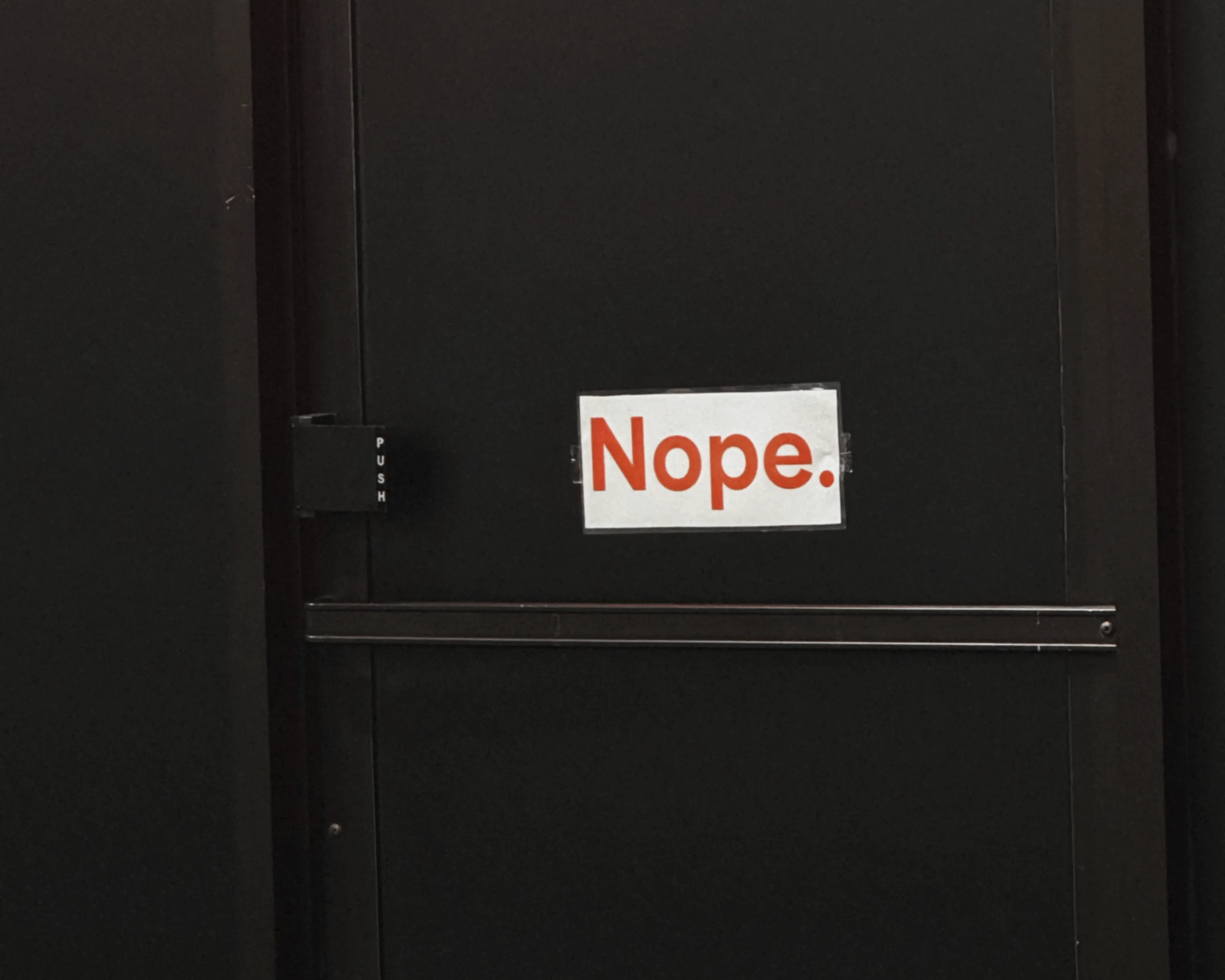
You can’t shortcut your way out of discomfort. Temporarily, maybe—with a bottle of liquor or a Vinted haul—but not foverer. At some point, you need to let yourself overthink, float in the grief, stall, and lose focus until some semblance of an answer arises from the mess. Because that week I spent going back and forth? It sure felt like a waste of energy at the moment. I felt like an indecisive dweeb. But it was the only way I was going to arrive at an answer that I could stand behind. Is there a way around it? Nope, amigos.
Be the first to hear about new posts, projects & experiments
Very occasional emails but always worth reading. Your inbox is literally drooling at the idea.
You agree to receive updates and consent to the Privacy Notice.